World-First Technology: Revolutionising Vehicle Interiors with Automated Suede Moulding
One of the projects recognized with the Honda President’s Award* in FY2025 is the development of a world-first automated suede application molding technology. Five team members who worked to bring suede—once limited to hand-applied use in high-end vehicles—to a wider range of customers share the factors behind their success and what they felt embodies Honda’s spirit through this project.
*President’s Award: Among Honda’s internal awards, the President’s Award is the highest honor. It is presented to initiatives that deliver high technical value or create new value, making a significant contribution to Honda’s business.
"If we achieve this, product appeal will soar"—The Vision That Started It All
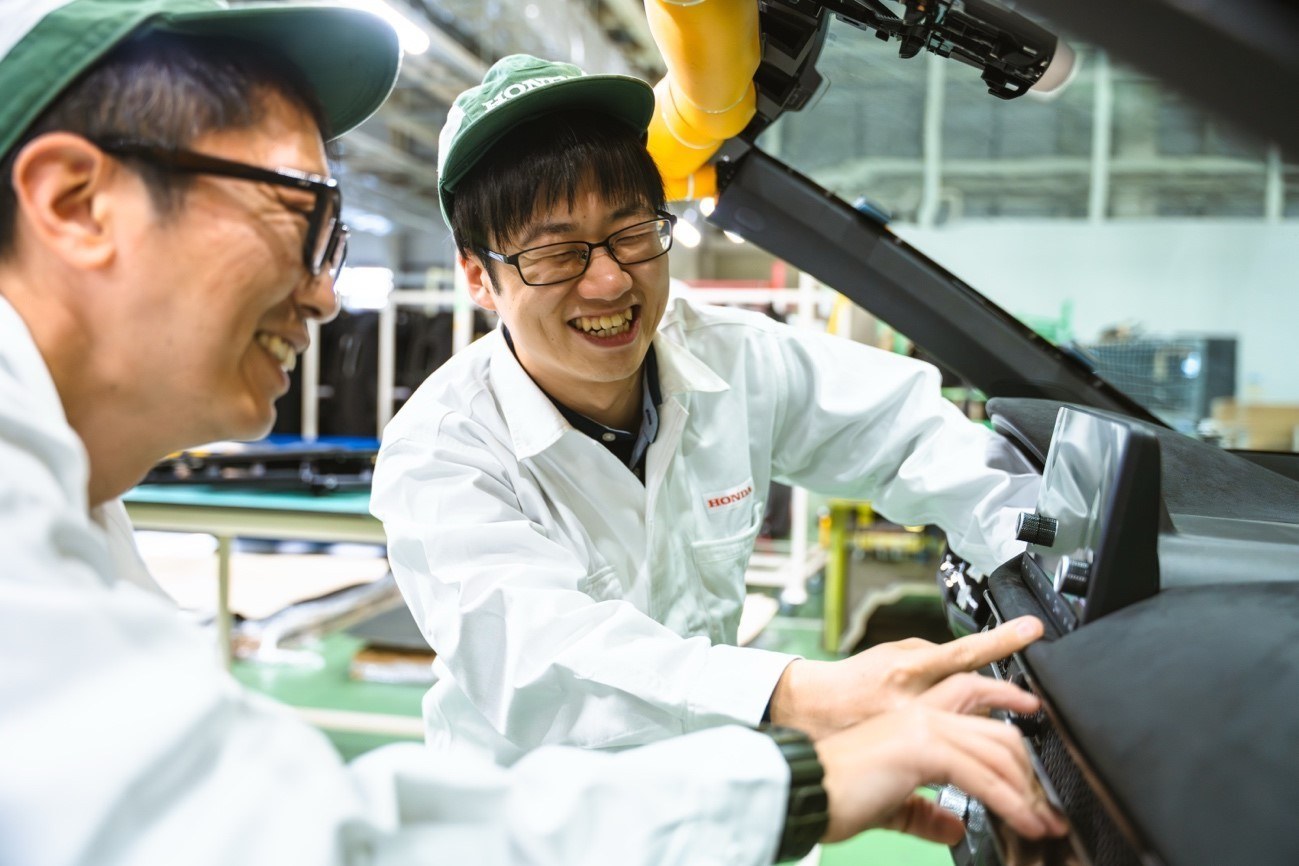
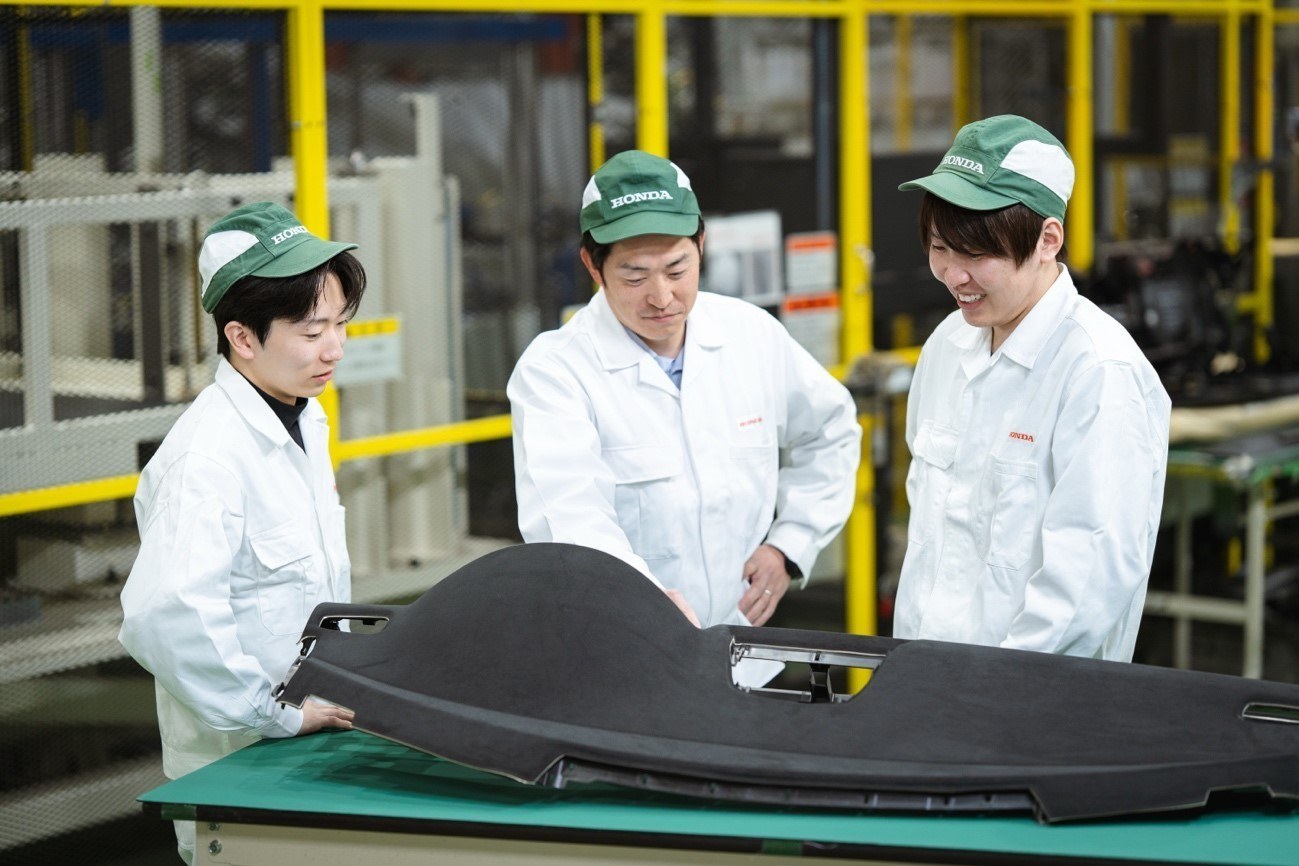
Shinno (left), Project Leader (PL), and Imai (right), responsible for moulding technology requirements.
—What inspired this project, and what were you aiming to achieve?
Shinno: We developed a technology that automatically applies suede to complex shapes. By enabling this intricate process to be designed with a production cycle equivalent to standard mass-production lines, we made it possible to apply the technology to mass-production vehicles.*
In recent years, there has been growing demand for more diverse interior expressions in automobiles. Suede materials, which offer a higher-quality feel and reduce windshield reflections, are increasingly sought after. However, due to its limited stretchability, suede has traditionally required skilled manual application, making it primarily used in vehicles costing tens of millions of yen. Especially for instrument panels (the area in front of the driver housing meters and controls), which contain critical safety components such as airbags and have complex shapes, as well as dashboards with large surface areas, synthetic leather with greater flexibility is typically used.
Within our department, the idea of using suede had been discussed for four to five years, but there were many barriers to changing materials. In addition, our production engineering division doesn't typically spearhead product appeal initiatives. However, Honda has a culture where anyone can propose an idea. So I took on the role of project leader and drove the initiative from the bottom up, believing that if we can achieve this, it will definitely enhance product appeal.
—What challenges did you face in developing the technology?
Imai: The most difficult part was establishing rules that would allow the technology to adapt to any shape. We built logic based on physical principles, conducted predictive analysis in advance, and then repeatedly validated it through trial and error, following Honda's Three Realities principle: the real place, the real thing, and the real situation. The process of achieving 100% reproducibility was both challenging and rewarding.
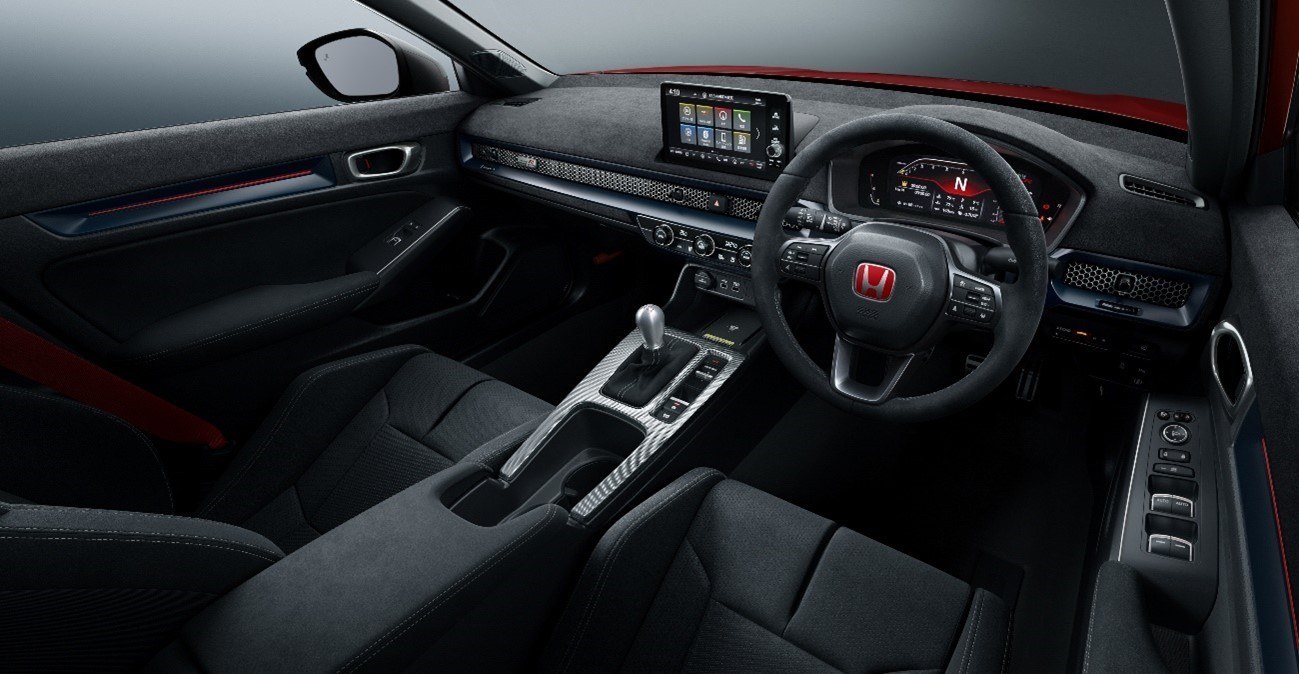
Adopted in the Civic Type R Racing Black Package
Overcoming one challenge after another through teamwork
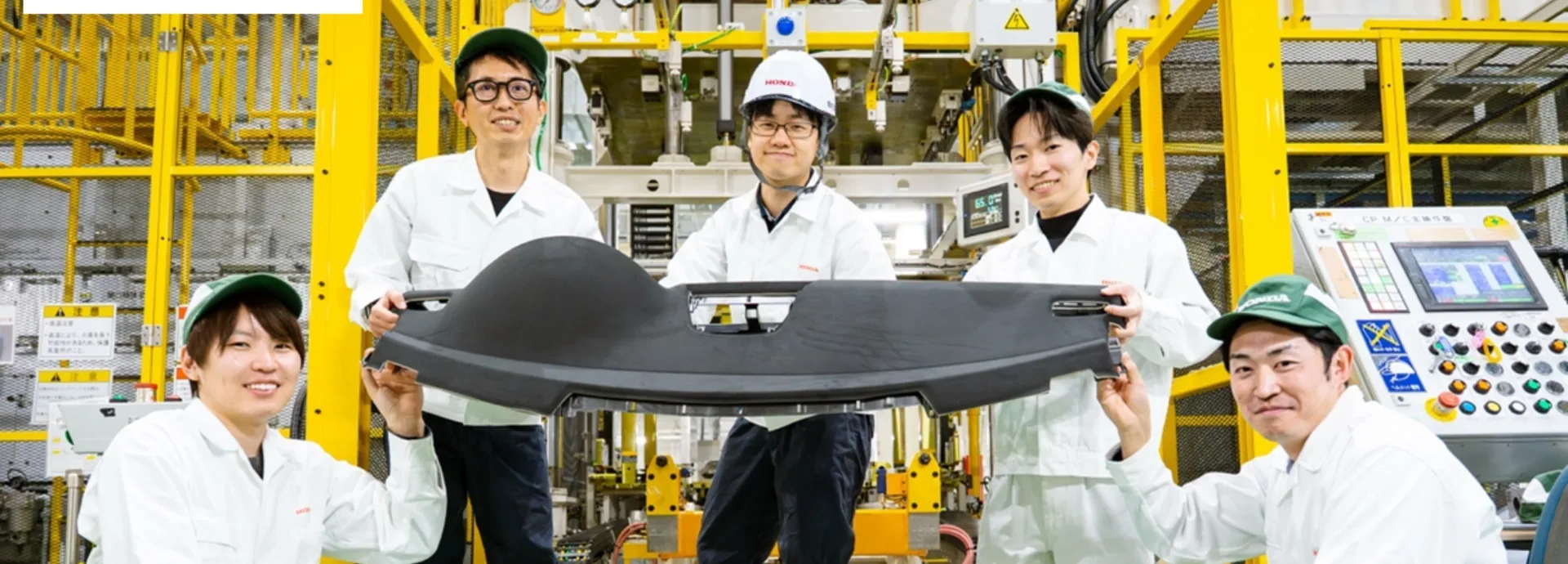
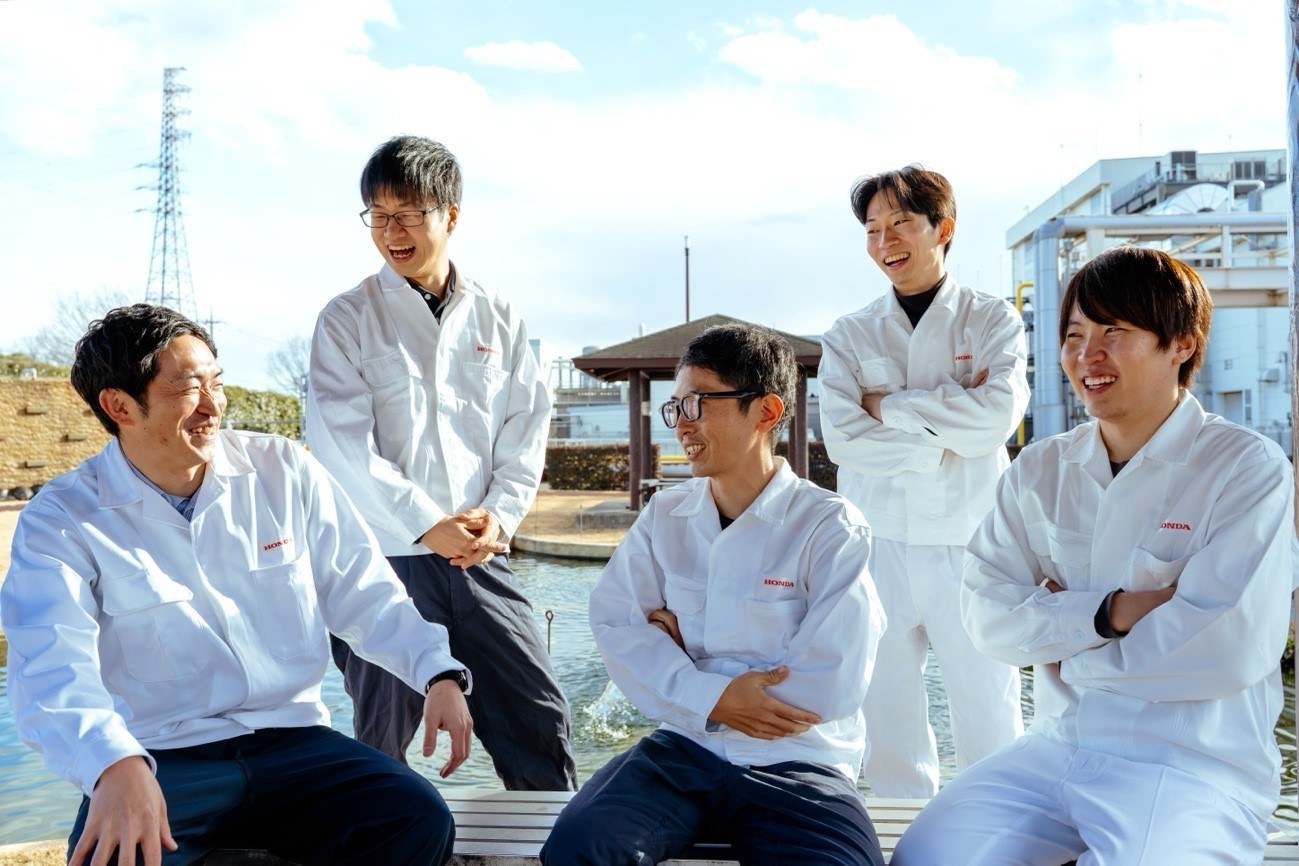
Fushima (left), responsible for moulding technology, and Kimura (centre) and Ishizaka (right), who led the introduction of the new technology into the mass-production line at the vehicle assembly plant.
—What challenges did the rest of you face? What contributed to the success?
Fushima: I joined this project from a different theme than the instrument panel and dashboard, and that perspective proved valuable.
Although Shinno and Imai had identified likely causes through repeated analysis, there were still issues that could not be resolved. I revisited the problem and, by examining it from many angles, identified improvement points that contributed to stable mass production.
Kimura: For me, the biggest challenge was implementing the new technology using the same equipment as mass production—ensuring that it would not cause issues in existing production lines. Each time we solved one issue on the test equipment, another would arise. Through this repeated process, we determined how to modify the production equipment.
Ishizaka: The key to success was the collaboration of everyone involved. It would not have been possible within our department alone. From equipment and manufacturing engineers to assembly line staff and product management teams, everyone worked positively toward the goal, making this achievement possible.
Breaking Silos: Achieving a World-First Through an “All Honda” Effort
Article content
—Introducing new technology into production lines involves risk. What do you think was the biggest success factor?
Shinno: It was definitely teamwork. In this project, members across the plant proactively considered and proposed methods for product management and care—areas typically handled by development teams. The project operated on a very tight schedule, but the factory team provided maximum support. It truly was an “All Honda” effort.
Another key factor was communication beyond departmental boundaries. Whenever confirmation was needed, action began immediately—sometimes with just a phone call. Whether it was positive outcomes or areas for improvement, everything was shared across teams regardless of roles.
I believe this was possible because of the strength of the product itself. When we showed the samples, people responded with “That looks great” and “Let’s do it.” There was a shared sense of figuring out how to make it happen. When we presented at an internal exhibition, we received positive feedback not only from associates across departments but also from management.
Imai: When I first heard about this project, I became an immediate fan. Seeing the sample made me think, “I want this car,” and “I wish there were more cars like this.” The challenge of making something that feels almost achievable—but not quite—was also compelling. It made me think that if we can solve this, it will be exciting.
Ishizaka: Even with model revamps, attention often goes to areas like the front bumper, which define a car’s fascia. Having worked on instrument panels for many years, I was excited to finally see them take the spotlight.
The Power of Alignment: How Shared Vision Drives Honda Forward
—What did you learn from this project, and what would you like to take on next?
Imai: At Honda, everyone is equal in the face of technology. That’s what attracted me to the company, and this project allowed me to take on a challenge that overturns conventional thinking in that kind of environment. I want to continue pursuing challenges that redefine what is considered “normal.”
Fushima: I want to apply this experience to other themes and become someone who can positively influence the entire division.
Ishizaka: I learned the importance of just giving it a try. Being able to complete this project while experiencing that mindset firsthand was invaluable. I want to continue valuing that approach.
Kimura: I learned a lot from Shinno’s leadership—how to build and guide a team as a project leader. I am now taking on that role myself, and I hope to build a strong team by applying what I’ve learned.
—What did this project reaffirm about Honda’s strengths?
Shinno: This was a challenge to create a new option where synthetic leather had been the only choice. The process involved constantly questioning, “Is this really the right way?”
But when everyone’s direction aligns, Honda generates tremendous power. While the company values individuality and may appear diverse, once a decision is made, everyone moves forward together at incredible speed. Moreover, there is an environment where people act proactively regardless of position or age, without waiting for instructions. That allows individuals to fully commit to what they believe in. That is what makes Honda unique—and why I feel glad to be part of Honda.