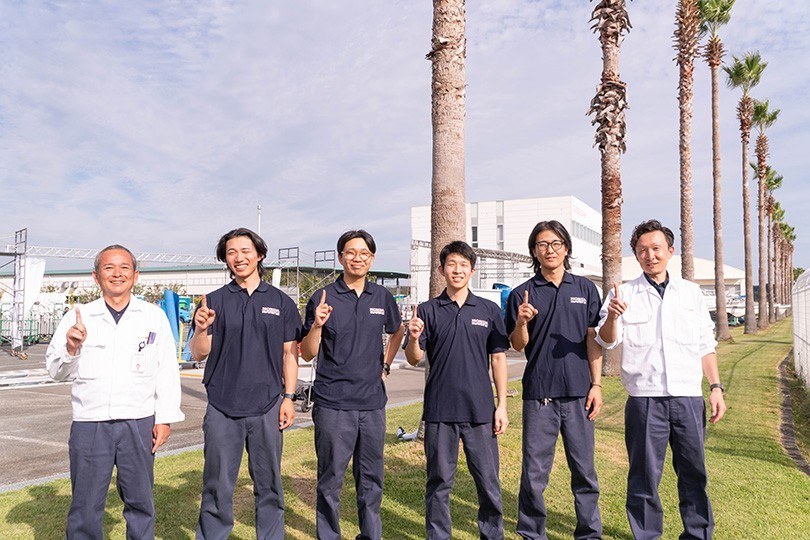
Honda Hosoe Outboard Engine Plant Celebrates 25 Years: Passing on the Spirit of Manufacturing
Located on the shores of Lake Hamana, Honda’s Hosoe Outboard Engine Plant celebrates its 25th anniversary in 2026. Since beginning full-scale operations in 2001, the plant has delivered high-quality outboard motors to customers worldwide while maintaining a strong commitment to environmental responsibility. Behind its manufacturing excellence are skilled craftsmanship, continuous ingenuity and close relationships among associates.
This issue of Honda Stories looks back on the plant’s history through its 25th anniversary celebration, exploring the Honda manufacturing philosophy that lives on at Hosoe and the spirit of challenge being passed down to the next generation.
Celebrating 25 years and sharing a united vision for the future
In October 2026, a ceremony commemorating the 25th anniversary of operations at the Hosoe Outboard Engine Plant was held beside Lake Hamana. Approximately 250 associates and guests gathered at the plant’s marina plaza to reflect on a quarter-century of achievements.
Following a commemorative video highlighting the plant’s history, Plant Manager Hiroki Chubachi addressed the attendees, expressing his gratitude to everyone who had supported the plant over the years and sharing his aspirations for the next 50 and 100 years.
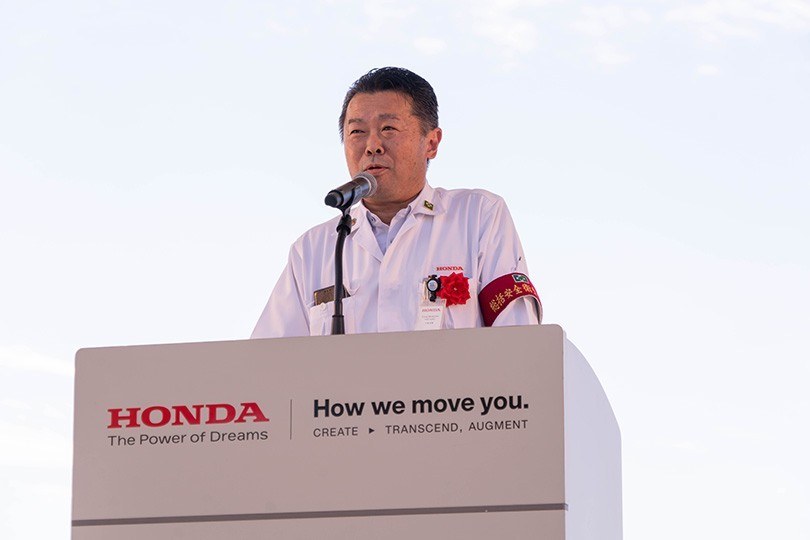
Chubachi: Over the past 25 years, we’ve reached many important milestones, including the transfer of production lines from the Hamamatsu Plant, structural reforms, the start of mass production of large outboard motors exceeding 200 horsepower, and the mass production of the BF350, Honda’s first V8 outboard motor.
Through all these milestones, we’ve continued to deliver the joy of being useful to customers around the world through Honda outboard motors.
I want this to be a year in which we make a commitment together to the next 25 years.
“Watercraft should not pollute the water”: 25 years in harmony with Lake Hamana
Honda began producing outboard motors at its Hamamatsu Plant in 1964. As production expanded to larger models, the existing facilities became increasingly constrained. Honda also needed a location where completed outboard motors could be tested immediately on the water.
The company therefore established a new production base in the former town of Hosoe, now part of Hamana Ward in Hamamatsu City, adjacent to Lake Hamana.
A comprehensive testing facility, including what is now the marina, was constructed in 1998, and the Hosoe Outboard Engine Plant began full-scale operations in 2001.
Noboru Sube, who served as project leader for machinery and equipment planning at the time, explains why the location was selected.
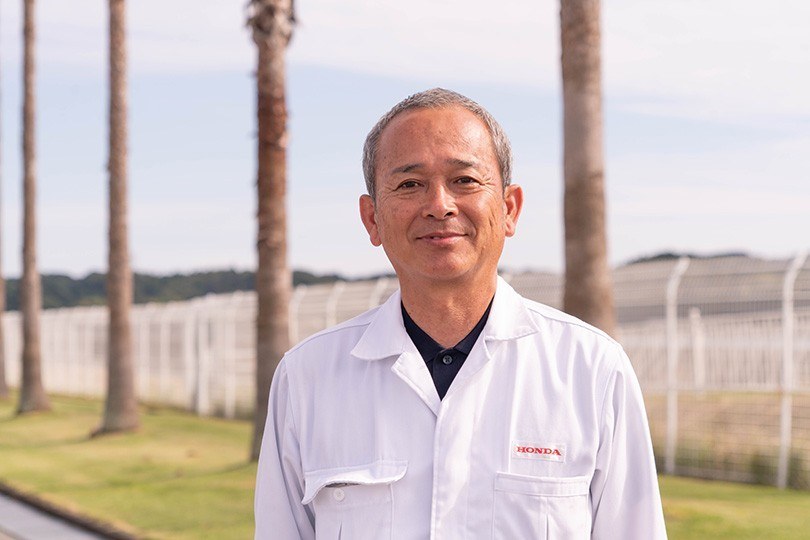
Sube: As we prepared to begin manufacturing larger outboard motors, Lake Hamana was an ideal location because we could conduct tests directly on the water. We started from scratch, determining what equipment we needed and how much space would be required, and developed the plant accordingly.
At the heart of Honda’s marine business is the philosophy that “watercraft should not pollute the water.”
Guided by this principle, Honda has pursued improvements in the environmental performance of its outboard motors while also taking extensive measures to minimize the environmental impact of production.
At Hosoe, situated beside the beautiful waters of Lake Hamana, particular emphasis has been placed on protecting water resources.
Rainwater collected from factory roofs is reused, while water used in final product inspections is circulated and reused. Rainwater runoff from the plant grounds is also checked for oil and other contaminants before being discharged.
The plant has also promoted decarbonization under Honda’s Triple Action to ZERO environmental initiative, announced in 2021. Measures include introducing solar power generation and converting heating equipment to electricity.
Sube: Through initiatives such as installing solar power systems and electrifying our equipment, renewable energy accounted for 51% of the electricity we used in 2025. These efforts have also received high recognition from outside the company.
The commitment we’ve maintained since the beginning—to use water responsibly and never discharge polluted water—continues to be firmly embedded in our daily operations.
Craftsmanship and ingenuity: The Hosoe approach to manufacturing
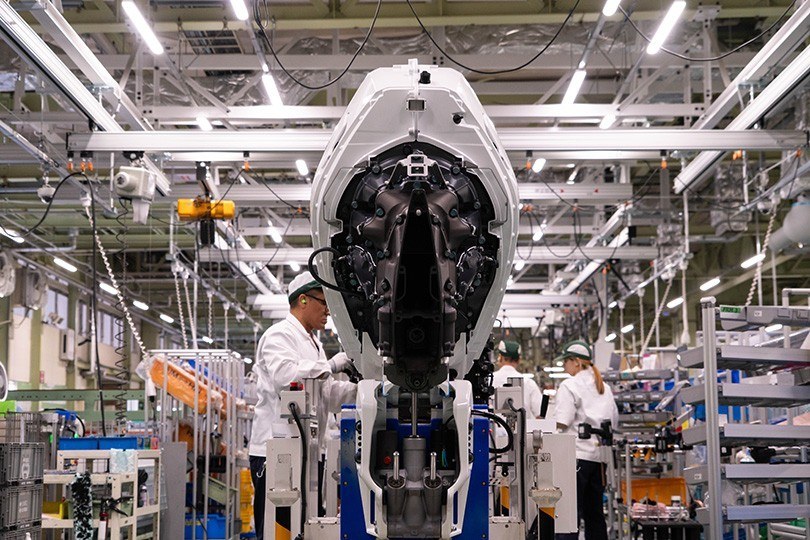
The Hosoe Plant produces outboard motors ranging from 2 to 350 horsepower. Its lineup includes the flagship BF350, powered by a 4,952 cc V8 engine, the largest engine in Honda’s outboard motor range.
Although Hosoe is a relatively small plant, it produces Honda’s only mass-production V8 engine, a significant source of pride for its associates.
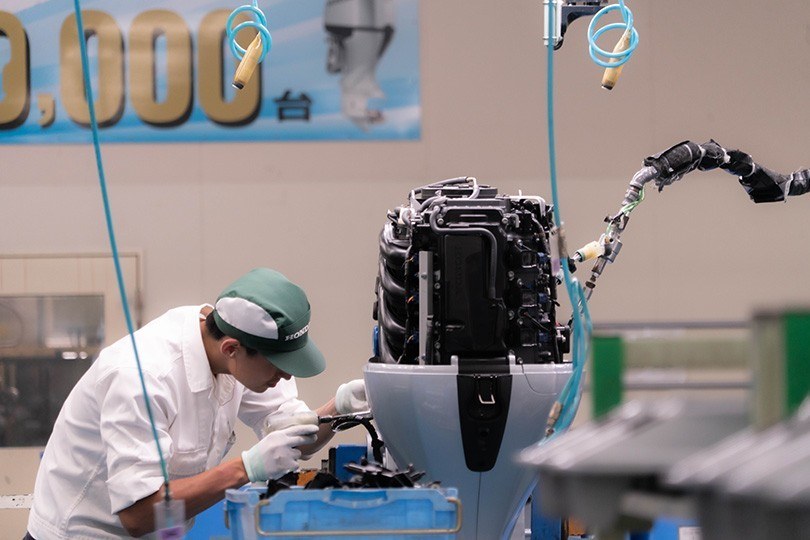
One of the major differences between manufacturing at Hosoe and Honda’s motorcycle and automobile plants is the emphasis on manual assembly and inspection processes that make full use of human skill and expertise.
Including detailed specification differences tailored to customers’ operating environments, the plant produces 470 variations across 26 models in 10 categories.
To accommodate this wide variety, Hosoe employs two distinct production methods.
A mixed-model assembly line handles 440 variations across 22 models ranging from 8 to 250 horsepower. Dedicated cellular production lines, meanwhile, allow small teams to assemble the compact BF2 and flagship BF350 models.
Masashi Oishi, who is responsible for assembly operations and production line planning, explains the technologies and ingenuity that make this high-mix production possible.
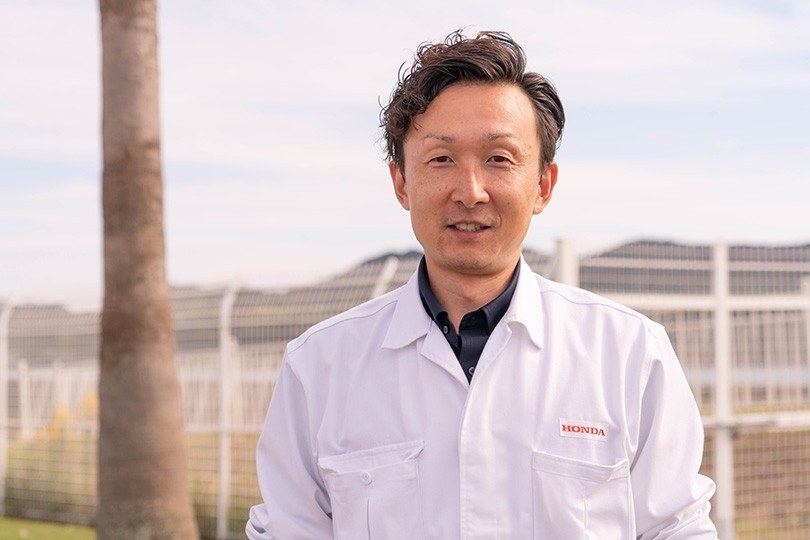
Oishi: Because we handle so many different models, operators have considerably more to learn. That’s why we carefully manage their skill development and daily staffing assignments.
Whenever we switch models, experienced support personnel use checklists to verify changes in components and other specifications. We work on engines with different specifications almost every day. That variety is part of what makes hands-on assembly so interesting, but it also means we have to remain constantly alert.
Supporting these manufacturing operations are the finely honed instincts and craftsmanship of experienced associates.
Oishi: Sometimes, while working, an operator notices that something feels slightly different about a component they’ve installed countless times before. On closer inspection, they discover a defect.
I think this ability to detect subtle differences is a uniquely human sensitivity developed through everyday experience.
Sube believes it is equally important to transform these individual skills and instincts into systems that everyone can use.
Sube: What’s important for the future of manufacturing is creating systems that enable anyone to assemble products correctly, regardless of age, gender or nationality.
For the BF350, Oishi and the other technical staff worked closely with the development team to improve ease of assembly, starting from the drawing stage.
We also introduced assembly fixture carts that our production associates conceived, designed and built themselves. It’s precisely in these systems and improvements that allow anyone to assemble products correctly that the craftsmanship we should pass on to the next generation is being put to use.
Advanced manufacturing at Hosoe depends on more than technical expertise. Another distinctive strength is the close relationship among the people working there.
Having spent approximately 20 years working at other facilities, including overseas production sites, before returning to Hosoe, Sube says he has rediscovered the plant’s unique sense of community.
Sube: Hosoe is Honda’s smallest production facility in Japan, with just under 300 associates. Everyone knows one another, and people work closely together.
Many people newly assigned here tell us that it’s a welcoming plant where everyone greets one another and it’s easy to feel at home.
An outboard motor is a product where an engine failure at sea can put lives at risk. That’s why everyone pays close attention to even the smallest details, and when something unusual happens, the response is extremely quick.
Coming back after 20 years, I’ve been reminded just how strong that commitment is.
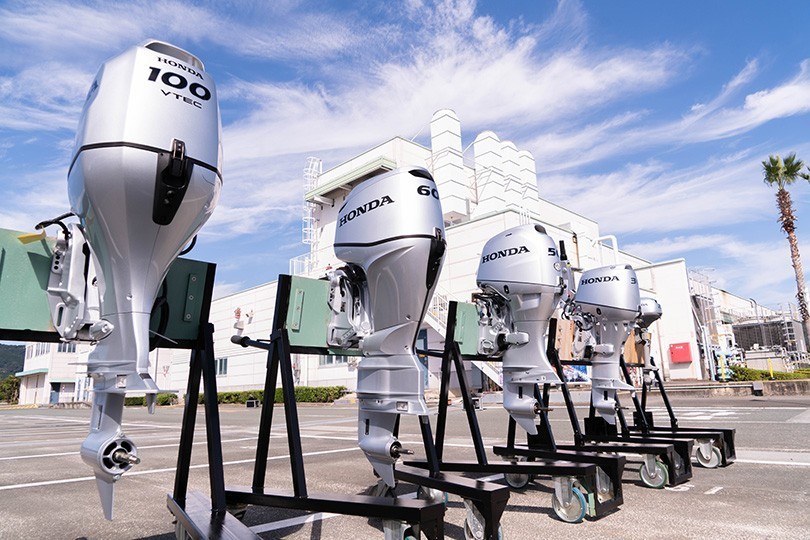
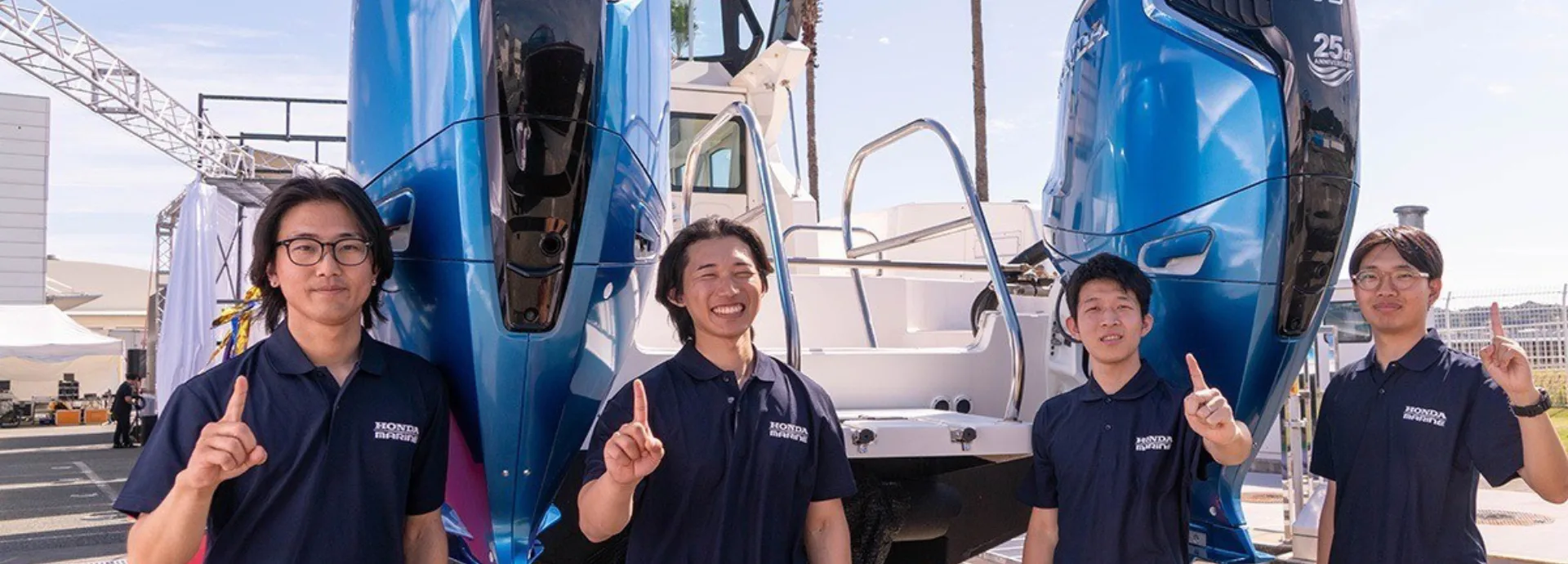
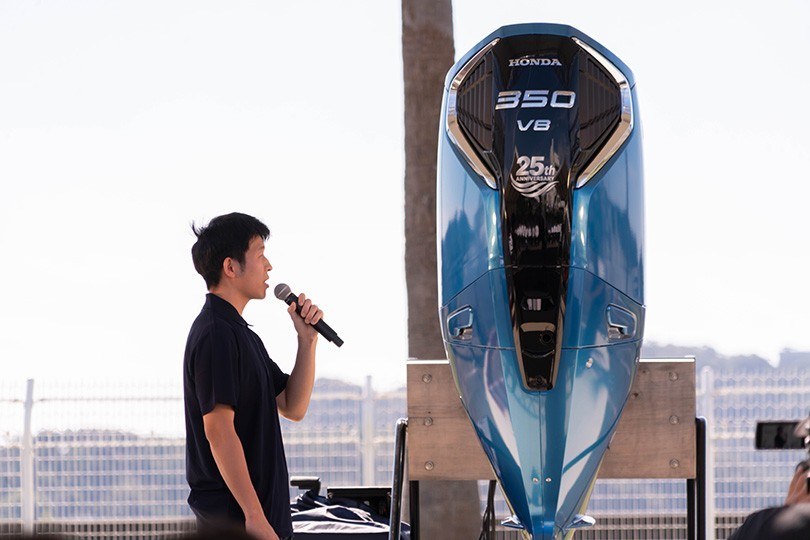
Part of the outboard motor lineup exhibited at the anniversary ceremony
Looking ahead to the next 25 years: Passing down the DNA of the challenger spirit
During the latter half of the ceremony, associates aged 25 who were born in 2001, the same year the Hosoe Plant began operations, took the stage to share their determination for the next 25 years.
One of them, Tomoya Shimamori of the Machinery Module, spoke about the meaning behind the special color chosen for the 25th anniversary commemorative outboard motor.
The color of the 25th anniversary outboard motor, Anniversary Blue, represents our wish to carry our dreams and aspirations from Lake Hamana to the world’s oceans and onward into the future.
We will continue moving forward with determination, building on the history created by our predecessors and doing our part to support the future of the Hosoe Outboard Engine Plant.
Next, Yudai Kakei of the Assembly Module delivered a Quality and Safety Declaration.
He pledged to carry forward the commitment to quality upheld by previous generations and to take responsibility for the safety and happiness of customers.
Meito Jin of the Quality Department then presented a Dream Declaration, expressing his ambition to inspire customers around the world through products he has helped create.
The young associates’ heartfelt declarations were met with enthusiastic applause.
Following the ceremony, Tadanori Ishibashi, who served as project leader for the anniversary event, expressed his gratitude to everyone involved and shared his ambitions for the future.
“I joined Honda because I wanted to bring smiles to as many people as possible. I want to keep taking on new challenges to create great products for people around the world.”
Reflecting on these promising young associates, Oishi and Sube identified one essential principle they believe should be passed on to the next generation: Honda’s Three Realities—going to the actual place, examining the actual part and understanding the actual situation.
Oishi: I want younger associates to become engineers who value the voices of people on the production floor.
When developing equipment or assembly fixtures, it’s important to listen to the people who will actually use them, understand what they really need and turn those needs into practical solutions.
Sube: I’d like them to develop their sensitivity not just by watching and listening, but by working with their own hands and experiencing things firsthand. Even as AI and automation advance, it’s still people who teach those systems what to do.
Hosoe offers an environment where associates can take on challenges of their own initiative, and I hope they’ll make the most of it.
Another principle both emphasized was an uncompromising commitment to quality.
Paying attention to every detail and pursuing consistently high standards are also essential elements of Honda’s manufacturing DNA that must be passed on to future generations.
Finally, Oishi and Sube shared their goals for the years ahead.
Oishi: As Honda’s only outboard motor plant, we want to preserve Hosoe’s craftsmanship and strong sense of unity while bringing in fresh perspectives, people and technologies.
By continuing to evolve our manufacturing, we hope to create even more fans of Honda Marine.
Sube: And we want Honda to become the number one outboard motor brand.
The 25th anniversary provided an opportunity to reaffirm the values that have guided the Hosoe Plant throughout its history: a commitment to environmental responsibility, manufacturing expertise refined on the production floor, and a determination to keep taking on new challenges.
With these values being passed from experienced associates to the next generation, the Hosoe Outboard Engine Plant continues its journey toward the next 25 years, creating products that support people on the world’s waterways.